
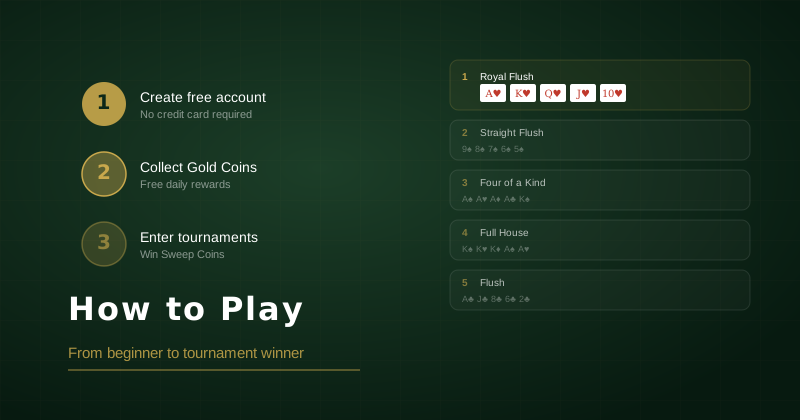
How to Play Global Poker Canada
From creating your account to cashing out real prizes — everything you need to know to get started and grow as a player.
5 Steps to Your First Cash Prize
Create Your Free Account
Go to global-poker.ca and click Register. Enter your email address, choose a password, and enter your date of birth. You must be 18 or older. No payment required at this step.
Collect Your Sweep Coins
Log in daily to build your streak bonus. Request free SC via mail-in. Optionally make your first Gold Coin purchase to trigger the welcome bonus and receive SC 2.50.
Pick a Game or Tournament
Open the lobby. Filter by SC tables — these use Sweep Coins and are eligible for cash redemption. Start at the lowest stakes (SC 0.01/0.02) if you're new to online poker.
Win and Accumulate SC
Play cards. Good decisions over thousands of hands build your SC balance consistently. Reach SC 100 to meet the minimum redemption threshold.
Verify Identity and Redeem
Submit a government-issued photo ID and proof of address through your account settings. Once approved (24–72 hours), request your cash prize via Interac e-Transfer.
Hand Rankings — Strongest to Weakest
Royal Flush
A K Q J 10 of the same suit. Unbeatable.
Straight Flush
Five consecutive cards, same suit. E.g. 7-8-9-10-J of hearts.
Four of a Kind
Four cards of the same rank. E.g. 4-4-4-4.
Full House
Three of a kind + a pair. E.g. K-K-K-7-7.
Flush
Any five cards of the same suit (not consecutive).
Straight
Five consecutive cards of mixed suits.
Three of a Kind
Three cards of the same rank.
Two Pair
Two separate pairs. E.g. A-A-8-8.
One Pair
Two cards of the same rank.
High Card
No hand made — highest card plays.
Position & Starting Hands
Starting Hand Strength by Position (6-max)
| Position | Raise Range | Call Range | Notes |
|---|---|---|---|
| UTG | 8–10% | Very tight | Play strong hands only |
| HJ | 14–16% | Tight | Add suited connectors |
| CO | 20–24% | Medium | Wider pairs, broadways |
| BTN | 40–50% | Wide | Most profitable seat |
| SB | 30–35% | 3-bet or fold | Positional disadvantage |
| BB | Defend wide | Price-based | Defend vs. BTN & SB |
💰 Recommended Bankroll by Stake
Based on 20 buy-in deep minimum. Conservative players use 30 BI.
10 Mistakes New Players Make — and How to Fix Them
| # | Mistake | Why It Costs You | Fix |
|---|---|---|---|
| 1 | Playing too many hands | Lose chips with marginal holdings | Start with top 15% hands from early positions |
| 2 | Ignoring position | Hard to make good decisions out of position | Tighten UTG, loosen BTN significantly |
| 3 | Chasing draws with bad odds | Negative expected value over many hands | Learn pot odds: need ~2:1 for open-ended draws |
| 4 | Never bluffing | Predictable — opponents never pay off | Bluff missed draws heads-up in position |
| 5 | Always bluffing | Called down by any pair, lose often | Only bluff when opponent's range is weak |
| 6 | Playing on tilt | Emotional decisions lose money fast | Set a stop-loss of 3 buy-ins per session |
| 7 | Moving up too fast | Underbankrolled, variance destroys stack | 20+ buy-ins at new stake before moving up |
| 8 | Ignoring pot control | Build huge pots OOP with one pair | Check back top pair on wet boards in position |
| 9 | Paying off river bets | Calling stations lose to value bets | Ask: "What worse hand bets this river?" |
| 10 | Not tracking results | Can't improve without data | Export hand history after every session |
Complete Beginner's Guide to Global Poker Canada (2025)
Global Poker Canada operates on a sweepstakes model that is fundamentally different from traditional real-money poker sites. Understanding this structure is the first step to making the most of the platform. Players receive Gold Coins (no cash value, used for practice) and Sweep Coins (SC — redeemable for cash prizes). The SC system is the heart of the poker experience: every SC won at eligible tables can eventually be converted to real money once you clear the SC 100 minimum redemption threshold.
The Sweepstakes Model Explained
Sweepstakes law allows promotional contests where no purchase is necessary. Global Poker satisfies this by offering the mail-in SC request — Canadian players can receive SC 0.34 by post without ever spending money. When a Gold Coin package is purchased, additional Sweep Coins are granted as a promotional bonus, not a purchase transaction. This legal framing makes the platform available to players across all Canadian provinces, not just Ontario where real-money online poker is provincially regulated.
Practically, the experience is indistinguishable from real-money poker. You sit at a table with other players using SC, the cards are shuffled by a certified RNG, and the winner takes the pot. Strategy, hand strength, position, and reads matter exactly as much here as they do at any real-money site.
Learning the Software Before Risking Sweep Coins
New players should spend their first sessions on Gold Coin tables exclusively. These tables work identically to SC tables — same interface, same hand logic — but losses cost nothing. GC tables let you learn the time bank, the bet slider controls, the multi-table hotkey system, and the fold/check buttons under pressure before real prizes are involved. Global Poker does not offer hand history on GC tables, so treat them as a live practice environment rather than a study tool.
Position — The Foundation of Profitable Poker
In Texas Hold'em, the button (dealer position) is the most valuable position at the table. It acts last in every post-flop betting round, giving you information advantage over every other player. At a 6-max table, the button opens approximately 45–50% of all hands profitably. Under the gun (first to act pre-flop) plays roughly 10% of hands for an experienced player. If you're unsure why this matters: acting last means seeing opponents' actions before making your decision, which is an enormous structural advantage that compounds over millions of hands.
Bankroll Management for Canadian Players
Canadian players new to online poker frequently underestimate variance. A 200-hand sample tells you almost nothing about your true win rate. At NL10 (SC 0.10/0.25 blinds), you can expect to experience standard deviations of 30+ buy-ins over 10,000 hands — meaning even a winning player might show a SC 300 loss over that sample before reverting to their true edge. Maintain 20+ buy-ins for your stake. At NL2, that's SC 40 — very accessible. At NL25, it's SC 500. Move down without shame if your roll drops below 15 buy-ins.
When to Move Up Stakes
The conventional standard is: move up when you have 25+ buy-ins for the new stake and have shown a positive win rate over 50,000+ hands at your current level. On Global Poker, volume accumulates quickly at micro stakes — 6-max tables deal 80–100 hands per hour. Three hours per day nets 240–300 hands, putting 50,000 hands at roughly 6–7 months. Patience here pays off: players who grind micro stakes seriously for six months before moving up hit low stakes with edge that less-prepared players lack.
Study Tools and Resources
- Hand history export: Available after each SC session. Import into PT4 or HM3 for leak analysis.
- Equity calculators: PokerStove (free) and Equilab help you understand hand vs. hand equity.
- Range trainers: Apps like GTO Wizard offer GTO range presets for NL Hold'em at different stack depths.
- Video training: Run It Once has a free tier. suited8-9 to suited A-K range videos are particularly applicable to Global Poker stake structures.
- Community: The r/globalpoker subreddit has active Canadian players posting hand reviews and strategy discussions weekly.
Once you've built your strategy foundation, put it to use across the full game selection in the poker lobby. Enter your first tournament on the tournament schedule page — start with a freeroll or SC 2 buy-in MTT. Collect bonus Sweep Coins through every method listed on the bonuses page. Download the mobile app to log in for daily bonuses on your commute. When you're ready to start, register for free — the whole experience is waiting.